
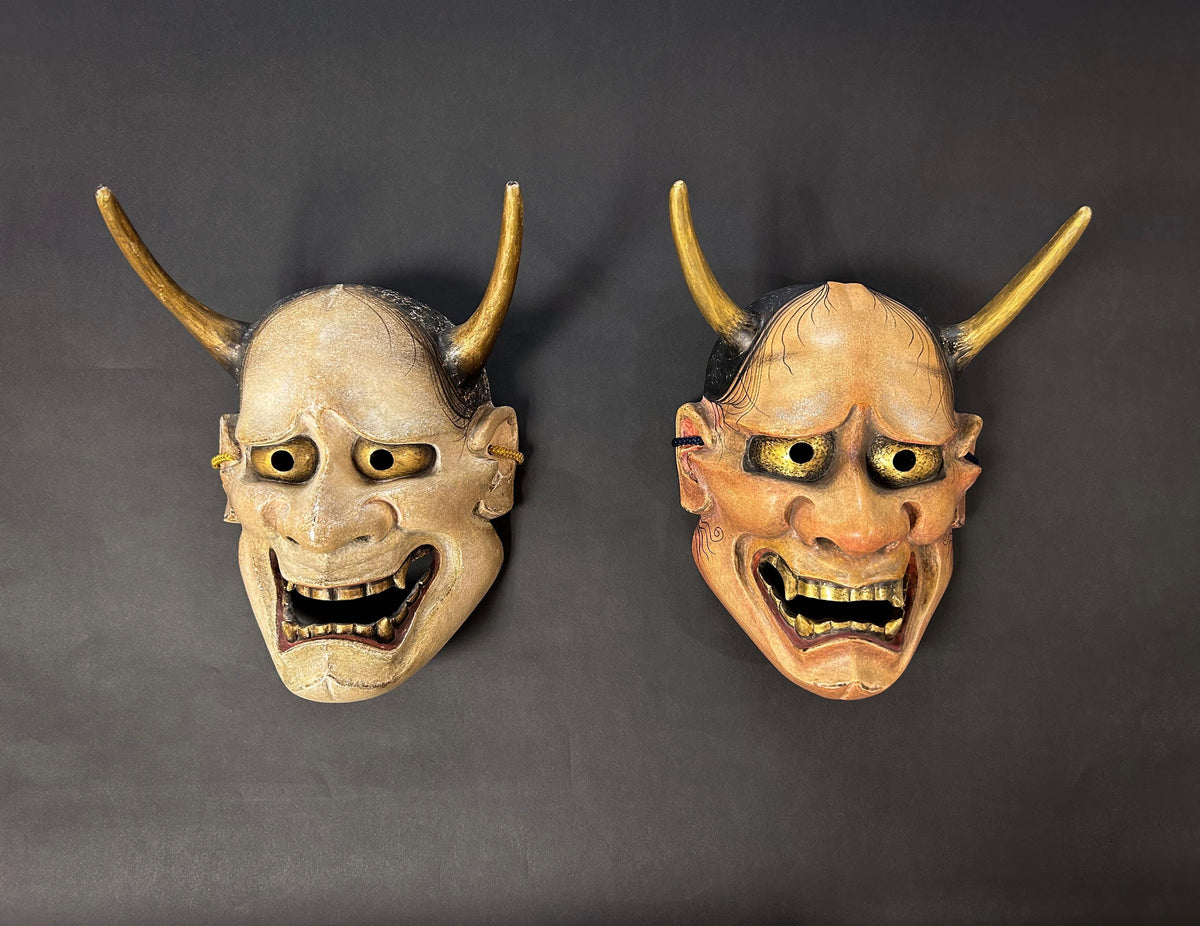
At Kyoto Handicraft Center, we carry a variety of traditional Japanese Noh masks. In recent years, we feel that Noh masks have become increasingly well known around the world.
Among them, there is one mask that almost everyone recognizes: Hannya.
When overseas visitors see our Noh masks, we are often asked:
"Do you have an Oni mask?"
And very often, the mask they are actually looking for is Hannya.
With her sharp horns, glaring eyes, and frightening mouth, it is easy to see why Hannya is often thought of as some kind of monster.
But here is an important point:
Hannya is not simply a demon. At the heart of Hannya is a human woman.
Her terrifying appearance represents powerful human emotions such as jealousy, anger, resentment, sorrow, and heartbreak taking on a frightening form.
So what exactly is Hannya, and what does this famous mask represent?
In this article, we will take a closer look at the meaning behind Hannya while also introducing a little about the fascinating world of Noh and Noh masks.
What Is a Noh Mask?
Noh is one of Japan's oldest traditional performing arts, with a history of more than 600 years.
It is a highly stylized form of theater in which actors use slow, deliberate movements, chanting, music, beautiful costumes, and masks to tell a story. Many Noh plays explore deep emotions such as love, jealousy, sorrow, regret, and revenge, often through stories involving spirits and supernatural beings.
Noh masks are used to portray women, elderly people, deities, spirits, and other characters. They are carefully carved with very subtle expressions, and although the mask itself does not move, its expression can appear to change depending on the angle of the actor's face and the way light falls on it.
A slight upward tilt may make a mask appear brighter, while a downward tilt can make the same face look sad, troubled, or frightening.
Manbi, a female Noh mask
This subtle expressiveness is one of the most fascinating characteristics of Noh masks.
So, What Is Hannya?
Hannya is one of the most famous masks in Noh.
Hannya mask by Hinako Horikoshi
In Noh, it is used to portray a Kijo—a woman transformed into a demonic form through overwhelming emotions such as jealousy, anger, resentment, and sorrow.
This is where Hannya differs from the image many people have of an Oni as a monster-like creature from folklore.
The frightening features of Hannya are not simply the face of a monster. They are a visual expression of intense human emotion.
The horns, glaring eyes, and sharp teeth show what happens when those emotions become so powerful that they seem to transform the person herself.
That human origin is one of the reasons Hannya is so compelling.
Hannya in the Famous Noh Play Dōjōji
One of the most famous Noh plays associated with Hannya is Dōjōji.
The story originates from an old Japanese legend about a woman who falls deeply in love with a Buddhist priest.
When she realizes that he is trying to escape from her, her love turns into intense anger and resentment. Overcome by jealousy and rage, she transforms into a giant serpent and chases him to Dōjōji Temple.
The terrified priest hides beneath a large temple bell, but the woman wraps herself around it and, burning with fury, kills him.
In the Noh play Dōjōji, years later, a mysterious woman appears at the temple during a ceremony for a newly restored bell. She dances, approaches the bell, and eventually reveals her terrifying supernatural form.
*Dōjōji-inspired image*
What makes the story especially powerful is that the horror comes from emotions that are entirely human.
Love, jealousy, anger, betrayal, and sorrow become something terrifying.
That is the world Hannya represents.
Do Women Have Horns?!
In Japanese culture, there has long been an interesting connection between women, strong emotions, and horns.
Traditionally, an angry or jealous woman has sometimes been imagined as metaphorically "growing horns," much like an Oni.
This idea can also be found in traditional Japanese wedding culture.
You may have seen the white headwear worn with a traditional Japanese bridal Kimono. One style is called Tsunokakushi.
Japanese bride doll wearing a traditional Tsunokakushi headdress
Literally:
Tsuno = horn
Kakushi = hiding
So the word can be translated as "horn hider" (horn cover).
One well-known symbolic explanation is that the bride hides her metaphorical "horns" of jealousy or anger as she enters married life.
There are several theories about the historical origins of Tsunokakushi, so this should not be taken as its only definitive meaning. Still, it reflects an interesting cultural association in Japan between strong female emotions and the image of horns.
Seen in this context, the horns of Hannya are not just frightening decorations.
They help give visible form to the emotions represented by the mask.
Look at Hannya One More Time
With her horns, sharp teeth, glaring eyes, and frightening mouth, Hannya gives a terrifying impression at first glance.
But try to imagine the horns hidden for a moment, and look only at her face.
Doesn't she look deeply sad?
In fact, she almost looks as though she is about to cry.
Hannya does not simply represent anger or jealousy. Her expression also contains profound sorrow and heartbreak.
That is what makes the mask so fascinating.
It brings together several intense emotions at once—anger, jealousy, resentment, pain, and sadness—and turns them into a single face.
Rather than showing a simple monster, Hannya reveals something much more complex: the darker and more painful side of human emotion.
Behind the horns and sharp teeth, there is still a very human sadness.
And finally, a little advice to husbands and partners around the world: